Here is a link to the entire assignment's information -> http://www.fcrr.org/studentactivities/C_014c.pdf
Tuesday, September 26, 2017
Resource Critique Activity
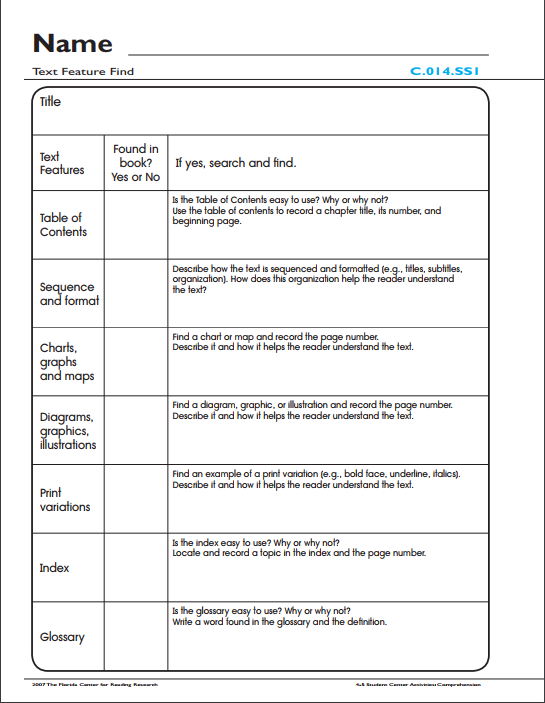
CPALMS has many different resources for educators. I decided to evaluate some resources I found for 4th grade teachers. There was a specific activity on having students having a scavenger hunt through a book. The standard it covered was LAFS.4.RI.3.7. The standard talks about interpreting information visually, orally, or quantitatively and being able to make sense out of it and say how it relates to the text its presented with. I think that this activity was a good way to check students ability to work with this standard in mind. Specifically, this assignment wants students to find specific things in the given book like a table of contents or charts/graphs. By finding these specific things in books, students are able to understand how they are found to be useful in books.
Here is a link to the entire assignment's information -> http://www.fcrr.org/studentactivities/C_014c.pdf
And above is a page of the assignment that would be given to the student!
Here is a link to the entire assignment's information -> http://www.fcrr.org/studentactivities/C_014c.pdf
Sunday, September 24, 2017
Journal 3
To be honest, I would be comfortable with teaching most of the ELH technology standards. Simply growing up with technology has made it easier for me to be able to understand it enough to teach. For example, I know i would definitely be able to teach things like online collaboration, citing, and being able to update online information. I like to think of myself as pretty tech savvy and would be able to figure out pretty much anything I might possibly ever have to teach my students!
The internet has so many resources that I can see myself using with my students one day. To start off, it's so easy for students to do further research on topics in class through the use of search engines and educational organizations that provide tools and resources for students. Blogs are also a big thing (obviously!). So I could see my own students having to make their own blogs one day. And as far as digital citizenship goes, the age of your students really affects what you would teach them. I want to teach around 4th grade so I would make it a point to talk about how to navigate the web. I'd also want to make sure they know how to protect themselves online on the internet! People can be crazy online so I would want to make sure that my students know how to keep themselves protected.
I really enjoyed doing the newsletter assignment! It was fun to play pretend and write an article for my imaginary students' parents. I got to learn some things that I actually didn't know how to do before this assignment. I hadn't ever had to make a border around words so I got to learn how to do that. Also I hadn't really done a lot of papers that required multiple columns so I got to figure that out too. There wasn't anything really specific that I didn't like about this assignment! I really enjoyed it in general. This assignment was such good practice for when I have a classroom of my own. Real teachers always are writing newsletters for parents- especially elementary school teachers!
The internet has so many resources that I can see myself using with my students one day. To start off, it's so easy for students to do further research on topics in class through the use of search engines and educational organizations that provide tools and resources for students. Blogs are also a big thing (obviously!). So I could see my own students having to make their own blogs one day. And as far as digital citizenship goes, the age of your students really affects what you would teach them. I want to teach around 4th grade so I would make it a point to talk about how to navigate the web. I'd also want to make sure they know how to protect themselves online on the internet! People can be crazy online so I would want to make sure that my students know how to keep themselves protected.
I really enjoyed doing the newsletter assignment! It was fun to play pretend and write an article for my imaginary students' parents. I got to learn some things that I actually didn't know how to do before this assignment. I hadn't ever had to make a border around words so I got to learn how to do that. Also I hadn't really done a lot of papers that required multiple columns so I got to figure that out too. There wasn't anything really specific that I didn't like about this assignment! I really enjoyed it in general. This assignment was such good practice for when I have a classroom of my own. Real teachers always are writing newsletters for parents- especially elementary school teachers!
Tuesday, September 12, 2017
Journal 2
Throughout my life as a student, Microsoft Word has been a program that I have used constantly. Nearly every writing assignment has been written on word and then printed or electronically turned in. Word is fairly easy to navigate through and has made it easy to write and edit essays. It makes it simple to make sure my work is presented in the best way possible. I think I first used Word in elementary school. So this program has been in my school life for many years and I expect it to be a part of it for many more years. My teachers, on the other hand, have also used Word a lot to make tests and quizzes. If it wasn't for word, I can imagine it would be a lot harder to formulate these assignments for the students.
Since I have been in elementary school, I have used copyrighted materials. As have my teachers! But since we have just used them for educational purposes, there are no issues with copyright laws. Fair use lets educators use materials if it helps their students learn. If you follow these laws, you won't have any issues. As a teacher making their own materials, you must be prepared to have your works used by other educators. When students create their own works, you can teach them about how their creations can be shared on the internet for others to view to benefit themselves.
Chapter 11 brought up multiple implementation issues. One of theses issues is cyberbullying. As someone who has been cyberbullied many times in the past(and present!) I feel very strongly on this issue. I also have learned a few ways to deal with this issue. I learned that being strong is the most important thing. People who use the internet as a place to say mean things are insecure mean humans who need to use the mask of the internet to try to make other people feel bad. Once one realizes that, the words from the cyberbullies don't mean as much. On a related note, cyberstalking is another issue that one may potentially deal with. The easiest way to deal with this issue is prevention. Make sure personal social profiles are on private and all public profiles show minimal information. One also should make sure they don't accidentally download dangerous files and such that could hack their computer and self-install stalking programs. Freedom of speech is a difficult issue that can come along with a lot of grey area. Many might think that "freedom of speech" means you can say whatever you want whenever you want! At possibly at the expense of others as well. This is not necessarily the case. When you say things online, especially in schooling settings, one must make sure to not offend fellow classmates and people online. In my future classroom, I'll make sure to bring up these issues and share these prevention tactics with my students.
Since I have been in elementary school, I have used copyrighted materials. As have my teachers! But since we have just used them for educational purposes, there are no issues with copyright laws. Fair use lets educators use materials if it helps their students learn. If you follow these laws, you won't have any issues. As a teacher making their own materials, you must be prepared to have your works used by other educators. When students create their own works, you can teach them about how their creations can be shared on the internet for others to view to benefit themselves.
Chapter 11 brought up multiple implementation issues. One of theses issues is cyberbullying. As someone who has been cyberbullied many times in the past(and present!) I feel very strongly on this issue. I also have learned a few ways to deal with this issue. I learned that being strong is the most important thing. People who use the internet as a place to say mean things are insecure mean humans who need to use the mask of the internet to try to make other people feel bad. Once one realizes that, the words from the cyberbullies don't mean as much. On a related note, cyberstalking is another issue that one may potentially deal with. The easiest way to deal with this issue is prevention. Make sure personal social profiles are on private and all public profiles show minimal information. One also should make sure they don't accidentally download dangerous files and such that could hack their computer and self-install stalking programs. Freedom of speech is a difficult issue that can come along with a lot of grey area. Many might think that "freedom of speech" means you can say whatever you want whenever you want! At possibly at the expense of others as well. This is not necessarily the case. When you say things online, especially in schooling settings, one must make sure to not offend fellow classmates and people online. In my future classroom, I'll make sure to bring up these issues and share these prevention tactics with my students.
Tuesday, September 5, 2017
Monday, September 4, 2017
Journal 1
There are many influences that push teachers to use technology in their classrooms. Simplicity is a big one. Technology also makes many once tedious tasks a lot quicker to accomplish. Grading can be easier, for example, with the use of a Scantron machine. Teaching concepts can be an easier task with different websites that make learning a fun game with virtual incentives for getting math questions right. For students, they can get an education that is geared to their specific needs. Students can work on problems at their own pace and receive immediate feedback for their responses. This ensures that no student is left behind and everyone receives what they need to succeed.
The ISTE standards are important for all teachers. The first standard of learning is one that I believe I can accomplish and really follow. I am learning something new about technology every day! Whenever I don't know what to do, I am quick to turn to the help of my peers. But a standard I might find more difficulty in is the fifth one. Although I am able to figure out technology, I don't think I'm very good at designing things... I like to think of myself as a creative individual, but I still think its hard to create things on my own. I will certainly do my best to make sure all my students are accommodated however I can, though!
Personally, I agree with the title "digital native " for describing the youth of today. By definition, digital youth is used to describe the children who grew up in this generation with constant access to computers, internet, and technology in general. So many young people are very capable of operating various types of technology on their own. Sometimes even more so than the adults! I do see many differences in how digital immigrants such as my teachers and me, a digital native, use technology. In general, I'm able to figure out problems and fix them a lot more so than my own teachers. I am also faster and operating electronics. There have been many situations in classrooms I've been in where the students have taught the teacher something they didn't know about technology. Between me and future students, I anticipate a smaller gap in technological skills than me and my teachers today. I believe I will be able to figure out and operate future electronics just as well as the future youth.
The ISTE standards are important for all teachers. The first standard of learning is one that I believe I can accomplish and really follow. I am learning something new about technology every day! Whenever I don't know what to do, I am quick to turn to the help of my peers. But a standard I might find more difficulty in is the fifth one. Although I am able to figure out technology, I don't think I'm very good at designing things... I like to think of myself as a creative individual, but I still think its hard to create things on my own. I will certainly do my best to make sure all my students are accommodated however I can, though!
Personally, I agree with the title "digital native " for describing the youth of today. By definition, digital youth is used to describe the children who grew up in this generation with constant access to computers, internet, and technology in general. So many young people are very capable of operating various types of technology on their own. Sometimes even more so than the adults! I do see many differences in how digital immigrants such as my teachers and me, a digital native, use technology. In general, I'm able to figure out problems and fix them a lot more so than my own teachers. I am also faster and operating electronics. There have been many situations in classrooms I've been in where the students have taught the teacher something they didn't know about technology. Between me and future students, I anticipate a smaller gap in technological skills than me and my teachers today. I believe I will be able to figure out and operate future electronics just as well as the future youth.
Subscribe to:
Comments (Atom)
